Estimation
Bar Bending Schedule (BBS): Cutting Length Formulas with Examples
BBS made simple — the unit weight formula (d²/162), standard bend deductions and hook lengths, and worked cutting-length examples for stirrups and cranked bars.
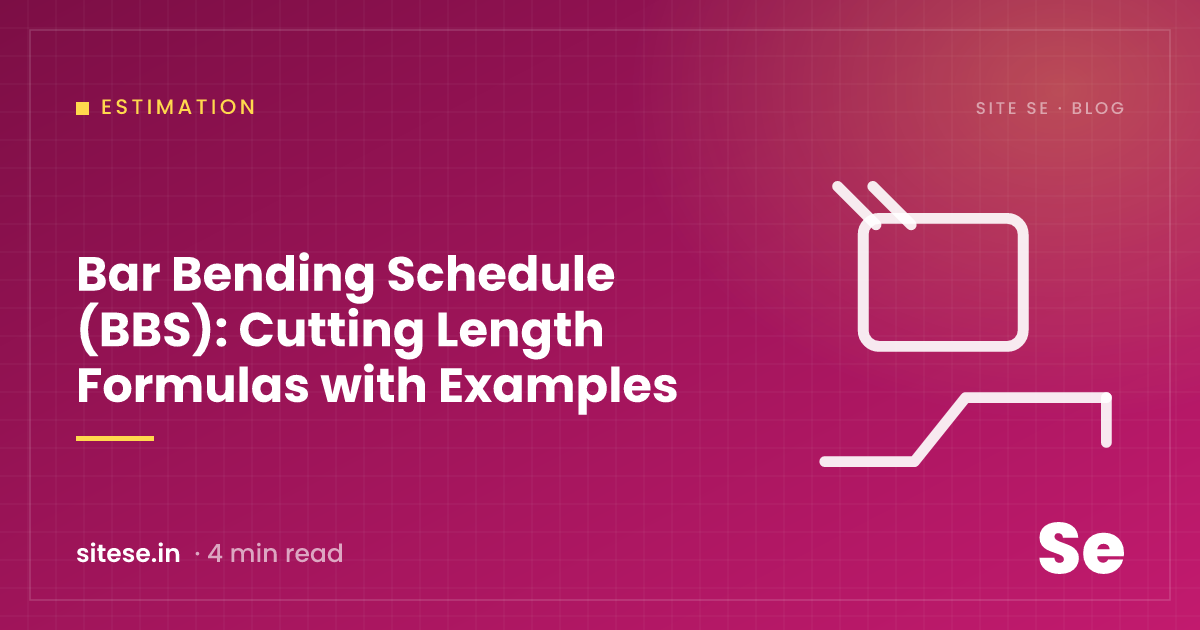
Steel is one of the most expensive materials on a reinforced-concrete site, and one of the easiest to waste. Cut bars by eye and you either run short or leave a scrapyard of offcuts. A Bar Bending Schedule (BBS) is how professionals avoid both — a precise list of every bar's shape, length, count and weight. Here is the small set of formulas that makes it work.
The one weight formula you must know
The weight of a round steel bar comes from a simple derivation of its volume and density. The result every site engineer memorises:
Unit weight = d² / 162 kg per metre (d in mm)
| Bar (mm) | Weight (kg/m) |
|---|---|
| 8 | 0.395 |
| 10 | 0.617 |
| 12 | 0.888 |
| 16 | 1.580 |
| 20 | 2.469 |
| 25 | 3.858 |
So 40 metres of 12 mm bar weighs 40 × 0.888 = 35.5 kg. This is how a BBS converts lengths into the tonnage you actually order.
Cutting length: the concept that trips people up
Here is the mistake: taking the dimensions off the drawing, adding them up, and cutting that length. That gives you a bar that is too long, because steel stretches at every bend.
The real relationship is:
Cutting length = Σ (straight segments) + hooks − bend deductions
Two adjustments matter:
- Bend deductions — subtract for the stretch at each bend: 1d for 45°, 2d for 90°, 3d for 135°.
- Hooks — for stirrups and ties, add a hook length of 9d (sometimes 10d) at each end.
These come from IS 2502, the code for bending and fixing of bars. Get them right and your bars fit first time.
Worked example 1: a rectangular stirrup
Take an 8 mm stirrup for a column of size 300 × 400 mm, with a clear cover of 25 mm.
Step 1 — Outer-to-centre dimensions Reduce for cover on both sides:
- Side A = 300 − 2×25 = 250 mm
- Side B = 400 − 2×25 = 350 mm
Step 2 — Perimeter 2 × (250 + 350) = 1200 mm
Step 3 — Add hooks, subtract bends A closed stirrup has two 135° hooks (9d each) and three 90° bends deducted (2d each), with the two hook bends (3d each) also accounted:
- Hooks: 2 × 9d = 2 × 9 × 8 = 144 mm
- Bend deductions: 3 × 2d + 2 × 3d = (3×16) + (2×24) = 48 + 48 = 96 mm
Cutting length ≈ 1200 + 144 − 96 = 1248 mm (≈ 1.25 m)
Multiply by the number of stirrups and the unit weight to get total steel.
Worked example 2: a cranked (bent-up) bar in a slab
A cranked bar rises at the support at 45°. Each crank adds an extra length and needs a bend deduction:
- Extra length for a 45° crank of depth D ≈ 0.42D per crank.
- Bend deduction ≈ 1d per 45° bend.
So for a slab bar with two cranks: cutting length = clear span + development lengths + (2 × 0.42D) − (2 × 1d). The exact numbers come from the structural drawing, but the method is always the same: segments + additions − deductions.
A sample BBS table
A finished BBS looks like this:
| Bar mark | Dia (mm) | Shape | No. | Cutting length (m) | Total length (m) | Weight (kg) |
|---|---|---|---|---|---|---|
| S1 | 8 | Stirrup | 60 | 1.25 | 75.0 | 29.6 |
| B1 | 16 | Straight | 8 | 6.20 | 49.6 | 78.4 |
| B2 | 12 | Cranked | 10 | 6.45 | 64.5 | 57.3 |
The last column, summed, is your steel order.
Why do it at all
- Less wastage — bars are pre-cut to exact lengths.
- Faster fabrication — the bender works from a list, not guesswork.
- Exact ordering — you buy tonnage, not "roughly some 12 mm".
- Clean billing — reinforcement is measured and paid on a documented basis.
The formulas are not hard, but doing them for every bar mark on every element — hundreds of lines, each with its own bends and hooks — is exactly the kind of repetitive work where a manual slip costs real money. Automating the arithmetic (while you keep control of the shapes and codes) removes the wastage without removing your judgement.
Frequently asked questions
What is the formula for the weight of a steel bar?
What is cutting length in BBS?
What are the standard bend deductions?
Why is a bar bending schedule important?
Related guides
 Estimation
Staircase Calculation: Riser, Tread & Concrete
Master staircase calculation for your construction projects. Learn to compute accurate riser, tread, and concrete quantities for safe, efficient…
Estimation
Staircase Calculation: Riser, Tread & Concrete
Master staircase calculation for your construction projects. Learn to compute accurate riser, tread, and concrete quantities for safe, efficient…
 Estimation
Precise Paint Calculation for Interior & Exterior Walls
Master accurate paint quantity calculation for interior and exterior walls. Learn how much paint needed, primer and paint coats, coverage, and…
Estimation
Precise Paint Calculation for Interior & Exterior Walls
Master accurate paint quantity calculation for interior and exterior walls. Learn how much paint needed, primer and paint coats, coverage, and…
 Estimation
Foundation Excavation Quantity: A Site Guide
Master foundation excavation quantity and earthwork calculation for your site. Learn pit volumes, working space, side slopes, bulking, and backfill…
Estimation
Foundation Excavation Quantity: A Site Guide
Master foundation excavation quantity and earthwork calculation for your site. Learn pit volumes, working space, side slopes, bulking, and backfill…